
The Week It Is Not There
A trial went back and weighed everybody a year after the injections stopped, and what it found is the reason this lesson exists.
Nobody enjoys reading it. Meeting it now, while the appetite help still works, beats meeting it later without warning.
The medicine is doing something for you today that somebody has to do on purpose tomorrow.
What follows is one measured result, with the parts usually left off it.
What the extension found
The trial randomised 1,961 adults to sixty-eight weeks of weekly semaglutide or placebo alongside a lifestyle programme. At week sixty-eight both the medicine and the lifestyle support were withdrawn, and 327 people were followed for another year.
Mean weight loss on the medicine had been 17.3 per cent. A year after everything stopped, participants had regained two-thirds of their prior weight loss, and a net loss of 5.6 per cent remained.
Two caveats travel with that number and the paper prints both. The analyses were exploratory. And the support was withdrawn on the same day the drug was, so the finding describes losing both at once.
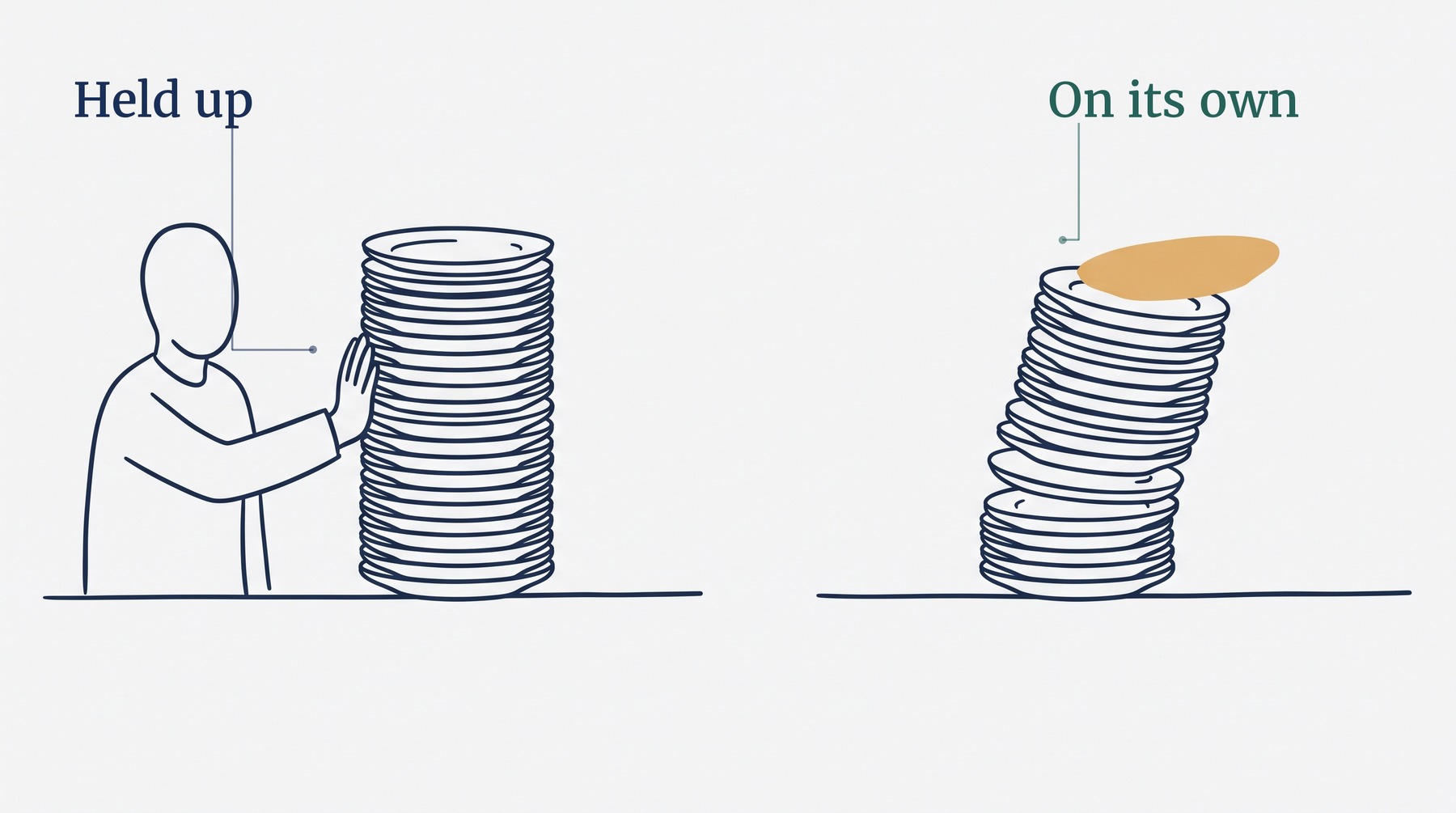
The stack was never the problem. What was holding it up was.
What the guideline body says about it
The national guideline body is blunter than any trial. It recommends the medicine alongside lifestyle interventions provided in specialist services, and it records that there is no evidence of effectiveness if semaglutide is used as a stand-alone treatment.
That sentence deserves reading twice. The pen is not the programme, and the guideline says the programme is the part that has to be there.
Why is the regain figure from that extension not a forecast about you?
The lifestyle support stopped on the same day the injections did, and the analyses were exploratory.
What does the guideline body say about the medicine used on its own?
There is no evidence of effectiveness for it as a stand-alone treatment.
So here is the question worth carrying out of this course. Which parts of your week are currently being run by the medicine, and would stop if it were absent?
The honest audit
A quieted appetite is doing an enormous amount of scheduling for you, silently, every day. Part of your week has already stopped needing it.
The shop that happens on the same day whether or not you feel like eating
The first bite that goes on the fork without a decision being made
The two strength session days that are in the calendar as appointments
The glass that gets filled because it lives by the kettle
Every ticked line is a piece of the week that would carry on unchanged next February. Every unticked one is currently being held up by something that will not always be there.
Count it before you judge it
None of this is a reason to stop anything. The NHS says plainly to talk to your doctor before stopping and never to stop suddenly.
It is a reason to know the number. Count your own week honestly before you decide what it is worth.
Whatever percentage came back, that is the part of your week you own outright today. So which single eating moment would you move across next?
The appetite is on loan. The habits built underneath it are not.
Where these facts come from
The trial figures come from a published extension study of a semaglutide trial, read from the paper's own abstract, including its statement that the analyses were exploratory and that the lifestyle programme was withdrawn alongside the medicine. The stand-alone sentence and the reference to specialist services are quoted from the national guideline body's own recommendations. The advice about never stopping suddenly is the NHS page for the medicine. The percentage in the panel is yours. Nothing here is a claim about Dr Olubunmi Aboaba or a forecast about you.